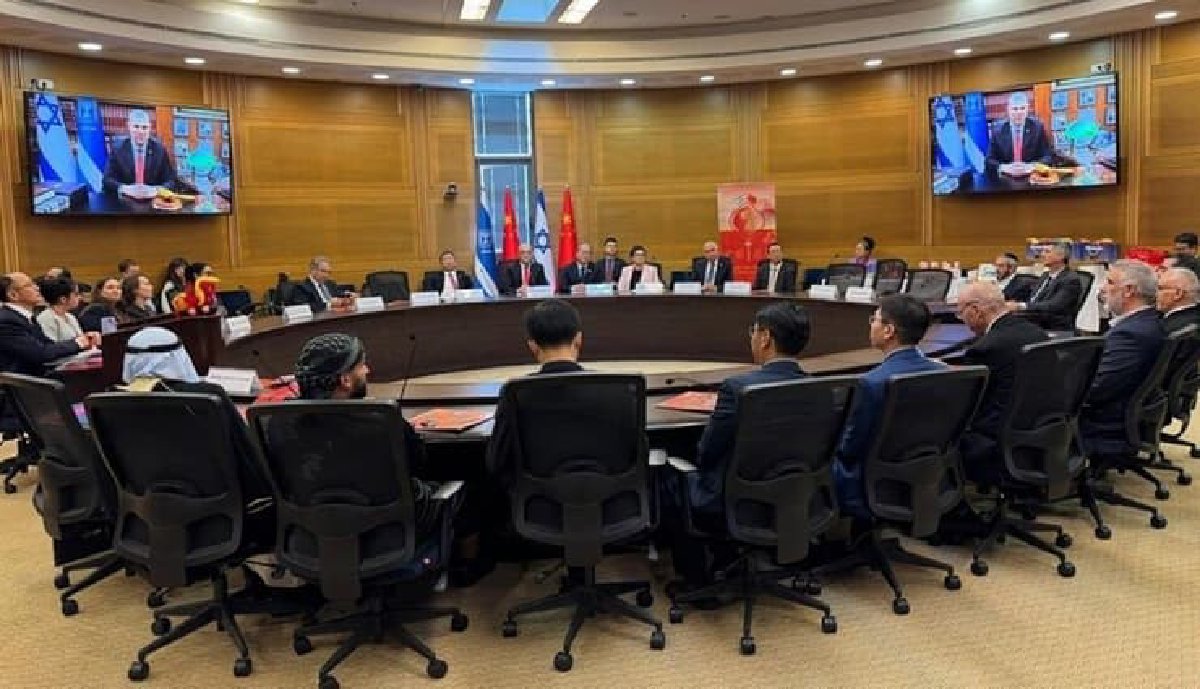
In an unprecedented event, the Israeli Knesset hosted a forum titled “Strengthening Israel-China Relations and Marking the Spring Festival” — the first time the Chinese Spring Festival has been celebrated in Israel’s parliament since the founding of the state. The event, initiated by the Chinese embassy, was hosted by coalition MK Akram Hasson (New Hope party) and Chinese Ambassador Dr. Xiao Junzheng, with the full Chinese diplomatic corps in attendance.
But the MK’s effusive praise for China’s supposed support of Israel has drawn sharp criticism from analysts who document a very different record.
MK Hasson’s Claims#
During the proceedings and in subsequent remarks to the Knesset plenum, Hasson publicly thanked China for being “among the few countries that condemned the massacre and what happened on October 7,” claiming that China “supported us and stood by our side.” He went further, describing China as one of the few countries that “did not allow” its 20,000 workers to leave Israel, and even suggested that China relocate its embassy to Jerusalem.
The Documented Reality#
According to Tuvia Gering, a cyber-threat intelligence analyst and visiting fellow at the Israel-China Policy Center at the Institute for National Security Studies (INSS), these claims “invert the documented reality of China’s conduct during Israel’s most severe crisis in generations.”
581 Days of Silence#
China’s first unambiguous, on-the-record condemnation of the October 7 massacre did not occur until May 10, 2025 — 581 days after the attack. It came in a pre-recorded interview with Ambassador Xiao for a small English-language Israeli podcast. This was an isolated event in a controlled setting, following 18 months of China repeatedly condemning Israel in international forums.
Diplomatic Actions Against Israel#
The record of China’s actions since October 7, 2023 paints a starkly different picture from Hasson’s claims:
- February 2024: China’s Foreign Ministry legal advisor argued before the International Court of Justice (ICJ) that Palestinian violence against Israel is not terrorism but a “legitimate armed struggle” and an “inalienable right.”
- July 2024: China’s Foreign Ministry hosted an official Hamas delegation for “reconciliation talks,” granting the terrorist organization international legitimacy.
- UN Voting: At every turn in the UNSC, UNHRC, and General Assembly, China pushed resolutions targeting Israel and pressured for “unconditional ceasefires.”
- September 2025: Prime Minister Netanyahu publicly accused China of running a media campaign and “legitimacy war” against Israel alongside Qatar.
The Noa Argamani Case#
China’s embassy rebuffed repeated requests to help secure the release of Noa Argamani, a half-Chinese Israeli hostage taken on October 7. Despite appeals from her family and a direct request from Prime Minister Netanyahu, Chinese officials reportedly cited that Argamani was only “half Chinese” through her mother and declined to take meaningful action.
Antisemitism on Chinese Platforms#
Outgoing Israeli Ambassador to Beijing Irit Ben-Abba confirmed that the wave of antisemitic and anti-Israel content on Chinese platforms was a deliberate, top-down political choice. She stated that Beijing “dictated harshly critical messages across every possible platform” while “hundreds of posts from the embassy and consulates were censored.” According to Ben-Abba, if Beijing had wanted to stop the incitement, it could have — because public discourse in China is “supervised, guided, and directed.”
The embassy has also made zero public mention of the four Chinese citizens murdered by Hamas on October 7.
The Workers Question#
The narrative around the 20,000 Chinese construction workers is more nuanced than Hasson suggested. While China did not evacuate these workers — whose continued presence prevented the collapse of Israel’s construction industry — it simultaneously refused to send additional workers despite an urgent need, and banned all new investment in Israel.
The “Beit Israel” Initiative#
One outcome of the Knesset event was the announcement by Itzik Moshe, an Israeli-Georgian businessman and associate of MK Hasson, of plans to open a “representative office” in China through his public-diplomacy organization Beit Israel. The initiative, intended to “tell the Israel story well,” would operate outside the Israeli Foreign Ministry’s oversight — which previously had issues with Moshe’s activities in Georgia.
Gering notes the obvious concern: “What China stands to gain in return, beyond another unregulated channel that bypasses formal state oversight and operates through moneyed elites.”
Taiwan’s Solidarity in Contrast#
While China turned a cold shoulder to Israel, Taiwan demonstrated full solidarity — a stark contrast frequently noted in Israeli media:
- Taiwan lit up Taipei 101 in support of Israel after October 7
- Taiwan made generous donations to Israel’s home front, including through Magen David Adom
- Taiwan awarded scholarships to Israeli students displaced by missile attacks
- Taiwan funded medical infrastructure in Israeli communities
As the Ynet report noted: “While China turned a cold shoulder to Israel, Taiwan demonstrated full solidarity and even showed it through generous donations to the Israeli home front.”
Strategic Analysis#
Gering characterizes China’s recent diplomatic warming — including this Knesset event — not as a moral awakening but as “Chinese transactional realism.” Israel’s battlefield victories, the fall of Assad, the degradation of Hezbollah, and the confrontation with Iran reshaped the region in ways that didn’t cooperate with China’s script.
The elite capture playbook is well-documented: target low-profile lawmakers with minimal China literacy, host lavish dinners at the ambassador’s residence, make modest gestures to an MK’s hometown, and turn these lawmakers into “ambassadors of friendship” who repeat Beijing’s talking points in the Knesset.
“A steady relationship must not be built on lies,” Gering concludes. “If Chinese diplomats, and Israeli lawmakers for that matter, want better relations, they must work for today and tomorrow, without inventing a history of solidarity that never existed.”
Sources: Ynet (Itamar Eichner), Discourse Power (Tuvia Gering)