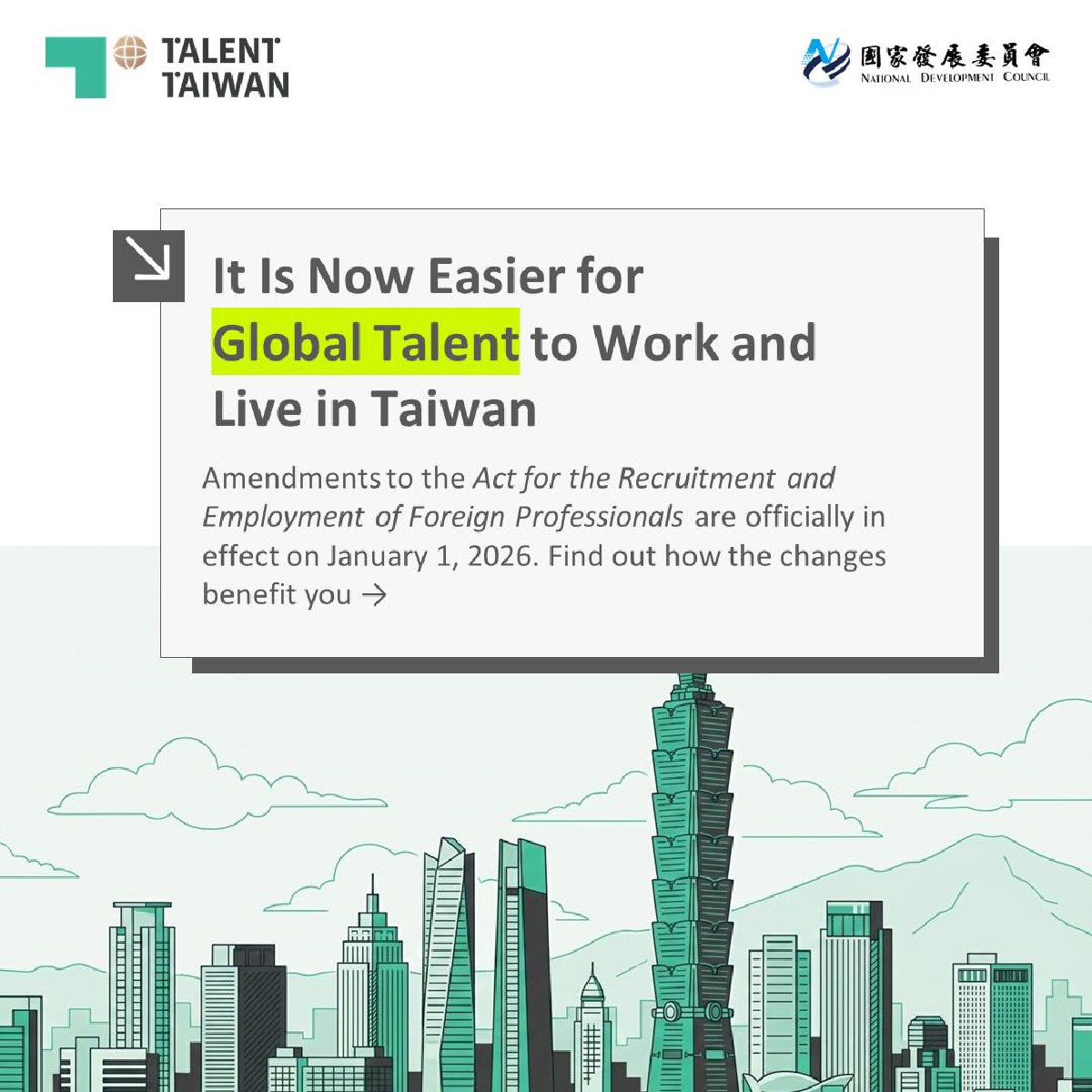
Taiwan has significantly lowered the barriers for international graduates looking to build careers on the island. Under amendments to the Act of the Recruitment and Employment of Foreign Professionals, which took effect on January 1, 2026, foreign students who graduate from Taiwanese universities can now remain in the country and work for up to two years without needing a work permit.
The policy change is part of Taiwan’s broader push to attract and retain global talent, and it carries direct relevance for Israelis studying in Taiwan as well as members of Asian communities in Israel considering educational opportunities there.
What Changed#
Previously, international graduates faced a tight window to secure employment and a work permit after completing their studies. The new rules grant an automatic two-year extension period during which graduates can seek jobs and work freely.
Graduates whose existing Alien Resident Certificates (ARCs) do not include the “work permit exemption” designation can apply for updated cards at any local National Immigration Agency (NIA) office. Processing typically takes several working days. The change applies to graduates from 2025 onward, with the extension period beginning after the original student visa or ARC expires.
Pathways to Long-Term Employment#
Beyond the two-year grace period, Taiwan offers several routes to securing a formal work permit:
Salary-based pathway — Graduates who receive a job offer with a monthly salary of at least NT$47,971 (roughly ₪5,500) can apply directly for a work permit without prior work experience.
Points-based scoring system — The most popular route among former students. Applicants accumulate points across eight criteria: education level, salary, work or internship experience (one year of internship earns 10 points), job qualifications, Chinese language proficiency, foreign language or overseas experience, policy compliance, and academic performance. A score of 70 points or above typically qualifies.
Intermediate skill workforce retention — Originally designed for blue-collar workers with six or more years of experience, this pathway now extends to graduates holding an associate degree or higher. It covers fields including caregiving, manufacturing, fishing, construction, and agriculture, with permits lasting up to three years.
Travel and accommodation sector — Since August 2024, foreign and overseas Chinese graduates have been eligible to work in Taiwan’s tourism and hospitality industry.
Practical Considerations#
For Israelis and other internationals weighing a move to Taiwan, the policy shift makes the country a more appealing destination for higher education. Completing a degree in Taiwan now comes with a built-in runway to establish a career — a significant advantage over many other study-abroad destinations.
Those interested in applying should check the National Immigration Agency website for current forms and requirements, or contact the Taipei Economic and Cultural Office in Israel for guidance.
Source: Taiwan in Israel Newsletter #43 via TECO Israel