In June 2004, Ehud Olmert — then Israel’s deputy prime minister and trade minister — slipped away from a business delegation in northeastern China for a private errand. He drove out to the Huangshan Jewish Cemetery on the wooded outskirts of Harbin and stood at the grave of his grandfather, Yosef Olmert. He laid stones on the headstone, recited the kaddish in Hebrew alongside his brother Amram, and afterwards spoke at length about a Chinese city he had never lived in but had grown up inside.
A House Full of Harbin#
Ehud Olmert was born in Binyamina in 1945, the son of two Harbin Jews who had emigrated to Mandate Palestine in the early 1930s. His father, Mordechai, had grown up in the Manchurian capital; his mother, Bella Wagman, came from the same community. The Olmert household spoke Russian, sang Russian songs, and — when memory turned eastward — slipped easily into Mandarin. According to Ehud, the last words his father uttered before his death in 1998 were in Chinese.
Mordechai went on to become a Knesset member for the Herut party between 1955 and 1961, in the political tradition of Ze’ev Jabotinsky’s Revisionist Zionism. The line connecting that hard-edged politics to a quiet Israeli childhood in Binyamina ran straight through Harbin.
Mordechai Olmert’s Manchurian Youth#
Mordechai Olmert was born in Buguruslan, in the Russian Empire, in 1908. His family fled the chaos of the Russian Civil War, arriving in Harbin in 1919, when he was eleven. He finished school in the city, helped found the local branch of Betar — the Revisionist Zionist youth movement — and in his early twenties taught Russian at a Chinese high school. In 1933 he and Bella left for Mandate Palestine.
That trajectory — Harbin as a Russian-Jewish way station between the Pale of Settlement and the Yishuv — was extraordinarily common. For tens of thousands of Russian Jews, an unlikely city in northeast China was the place where Zionism stopped being an idea and became a plan.
How Jews Came to Harbin#
Harbin barely existed before 1898, when Russia, having leased a concession from the Qing court, began driving the Chinese Eastern Railway across Manchuria as a shortcut for the Trans-Siberian. To populate its new outpost, the Tsarist government quietly suspended the residency restrictions Jews faced inside Russia proper. Jewish merchants, doctors, and engineers responded by moving east.
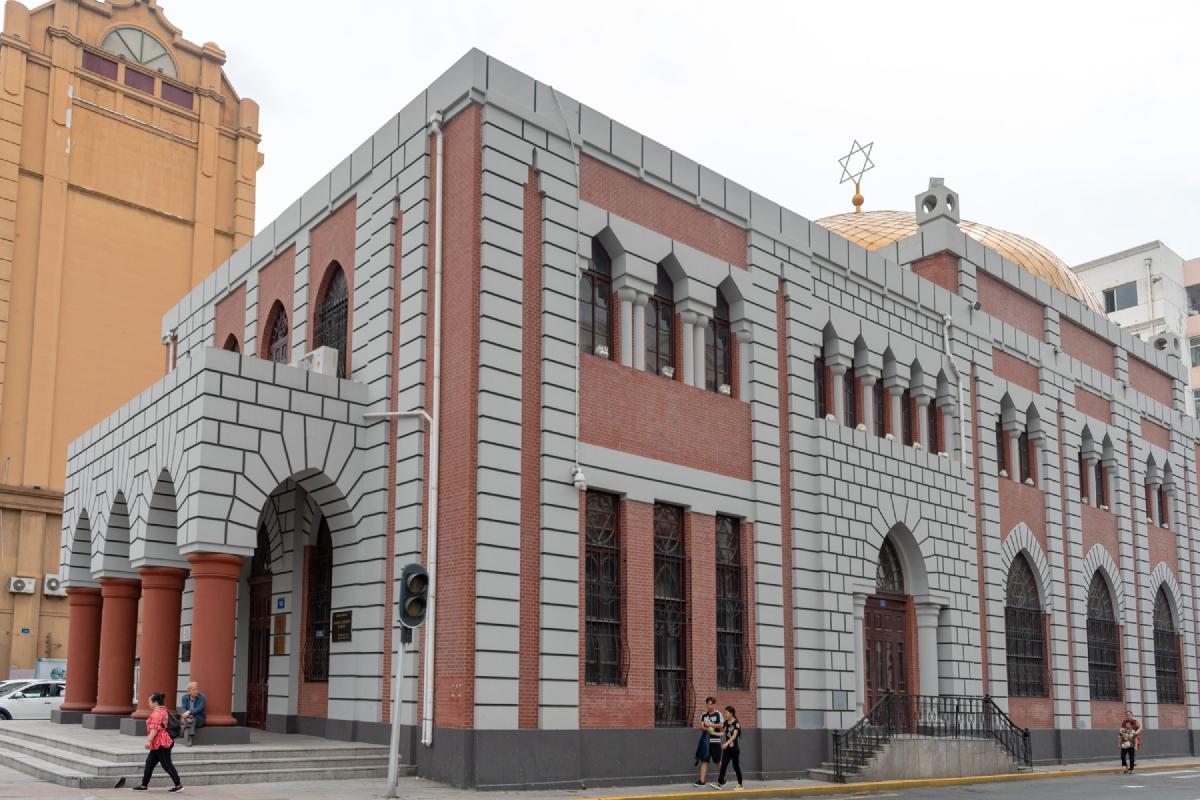
The community was formally constituted in November 1903 with around 500 members. By 1908 it had grown to 8,000. By the late 1920s, with successive waves of refugees from Tsarist pogroms, the Russian Civil War, and Soviet repression, Harbin’s Jewish population reached around 13,000 — the largest Jewish community in the Far East. The first synagogue went up in 1907; the larger New Synagogue, designed by the Jewish architect Yosef Levitin, opened in September 1921 and could seat eight hundred worshippers.
It was a strikingly autonomous world. Rabbi Aharon Moshe Kiselev led the community from 1913 until his death in 1949. Dr. Avraham Kaufman, who chaired the community council from 1933 to 1945, oversaw a Jewish hospital, schools, a Russian and Yiddish press, and the Zionist youth movements that included the young Mordechai Olmert.
The Long Decline#
The Japanese occupation of Manchuria in 1931 and the founding of the Manchukuo puppet state in 1932 changed everything. Far-right Russian émigré groups, operating under loose Japanese protection, began extorting and abducting wealthy Jews. The breaking point came in 1933, when Semyon Kaspe — a French-citizen concert pianist and son of the Jewish owner of the Hotel Moderne — was kidnapped, mutilated, and murdered. The Japanese authorities took no real action. Within a few years, most of those who could leave had left, for Tianjin and Shanghai, for the United States and Australia, and for Palestine.
After 1945 the Soviet army’s brief occupation effectively ended Zionist activity; Dr. Kaufman himself was deported to a Soviet labour camp. Communist rule, the Cultural Revolution, and ordinary attrition completed the work. The community’s institutions formally closed in 1963. Hanna Agra, the last Jewish resident of Harbin, died in 1985.
A Prime Minister Returns#
Ehud Olmert’s 2004 visit to his grandfather’s grave was reported widely in the Chinese, Israeli, and international press, and it set off a small renaissance. The local government accelerated restoration of the Huangshan cemetery — the largest surviving Jewish cemetery in the Far East, with roughly six hundred graves — and in 2005 a delegation of about a hundred Israelis of Harbin descent travelled back together to walk the rows of headstones. By the time Olmert became prime minister in 2006, Harbin had quietly repositioned itself as one of China’s most-promoted Jewish heritage sites.
Harbin Today#
The New Synagogue on Tongjiang Street has been restored and now operates as the Harbin Museum of Jewish History and Culture. The old Jewish Middle School is a museum too. The cemetery is signposted, with a Hebrew-language notice at the entrance. There are no Jews left.
For an Israeli audience, the Harbin story sits oddly between two more familiar narratives — the wartime Shanghai refuge of the 1940s, and the older Jewish trading communities of Kaifeng. It is neither. It is the story of a Russian-Jewish city built almost from scratch in northeast China, of children like Mordechai Olmert who grew up bilingual in Mandarin and Yiddish, and of how thoroughly that world has now vanished — except inside the families who left, of which the Olmerts are only the most politically prominent.
Sources: Wikipedia: Mordechai Olmert, Wikipedia: History of the Jews in Harbin, China.org.cn: Finding Family Roots at Harbin’s Jewish Cemetery, China Daily: Israel deputy PM visits grandpa’s Harbin grave.